Artisan Sterling Jewelry Develops Character Through Everyday Wear
Artisan Sterling Jewelry Develops Character Through Everyday Wear
Sterling silver has a cooler, quieter tone than yellow gold, but it is not visually flat. A polished section can throw a sharp white glint across a room, while a brushed or oxidized surface absorbs light and gives the metal a smoky depth. In a handmade piece, these finishes often sit close together. A stamped line catches brightness along its edge. A hammered area breaks the reflection into small, irregular points. The effect is noticeable without being loud, which is one reason sterling works so naturally in everyday jewelry.
The best artisan pieces usually have a sense of proportion that becomes clear only after wearing them for a while. A pendant should rest near the collarbone without flipping over whenever the wearer bends down. Earrings need enough weight to move but not so much that they pull at the lobe by late afternoon. A cuff may look substantial on a table and feel surprisingly unobtrusive once it is on the wrist. These details rarely appear in a description, yet they determine whether a piece becomes part of someone’s routine or spends most of its life in a drawer.
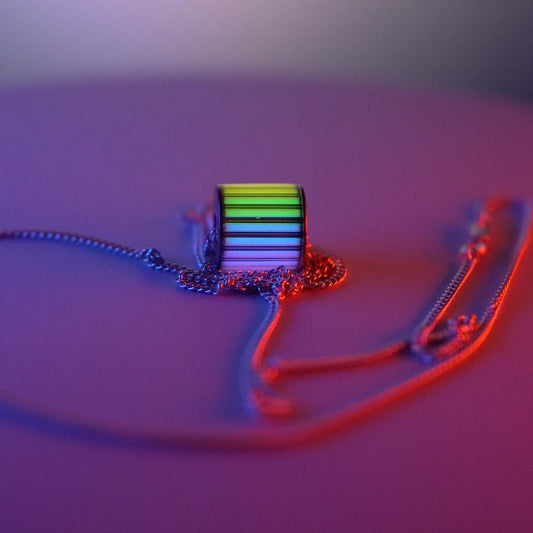
Necklaces are especially revealing. A broad pendant can seem carefully composed in a photograph, but on the body it may sit differently depending on the neckline, the chain length, and the wearer’s posture. A smaller handmade charm often finds its place more easily. It settles into the hollow above the sternum, shifts slightly as the wearer walks, and occasionally disappears beneath a shirt before reappearing at the collar. That intermittent glimpse can make it feel more personal than a piece that remains fully visible all day.
The same is true of rings. Artisan sterling rings often show their character through surface rather than scale. A softly irregular band, a low bezel, or a narrow strip of darkened silver can accompany other rings without making the hand look arranged for display. It may sit beside a plain wedding band, a signet, or an old ring inherited from a relative and gain meaning from the combination. Sterling is forgiving in this way. Its cool tone can bridge different metals, though the contrast becomes clearer as each surface develops its own wear.
Regular use changes silver quickly enough to be visible, but slowly enough to feel personal. Fingers polish the high points of a ring. A bracelet picks up fine scratches where it meets a desk, a watch, or the edge of a sleeve. A pendant may keep a bright front while the back becomes dull from contact with skin and clothing. Tarnish gathers more readily in crevices, around settings, and beneath overlapping forms. Some people clean these changes away; others leave them because the softened contrast makes the design easier to live with.
That aging is not always romantic. Silver can scratch, bend, and lose its shine. A delicate clasp can become irritating if it is too small to handle, and a thin chain may not suit a pendant with real weight. Stone settings deserve a close look too. A cabochon held in a low bezel tends to feel secure and tactile, while an exposed prong setting can give more light to a stone but may catch on knitwear. These are practical distinctions, not flaws in the material. They are part of the conversation between a piece’s design and the life it has to withstand.
Handwork is often visible in the places a catalog image would crop out. The inside of a ring may retain slight tool marks. A pair of earrings may not match with machine-perfect sameness, though they should still hang evenly. The back of a pendant may be finished simply rather than decorated, but it should not feel sharp against the skin. A well-made clasp closes with a small, definite resistance. None of this requires a piece to look precious or immaculate. It asks for attention to the parts that make wearing it comfortable.
There is also a particular emotional usefulness to artisan sterling jewelry. It can mark an occasion without looking confined to that occasion. A silver pendant received for a birthday may become part of a workday uniform. A ring bought during travel may lose its original setting over time and acquire another one through repetition: worn while cooking, driving, writing notes, or holding a child’s hand. Because sterling is comparatively approachable in appearance and price, people are often willing to wear it through ordinary life rather than reserving it for formal moments. That is where its character accumulates.
I have noticed that the pieces people keep reaching for are rarely the most elaborate ones. They tend to have one memorable decision: a flattened edge, a darkened groove, a stone with an uneven natural surface, a chain that falls at exactly the right place. They cooperate with the rest of what someone is wearing. A silver bracelet can slide beside a leather watch. Small earrings can remain visible under loose hair. A textured ring can catch the light while the wearer gestures, then disappear into the hand again.
Artisan sterling jewelry has room for that kind of quiet familiarity. Its appeal is not that it stays untouched. It is that the metal gives evidence of touch, movement, cleaning, neglect, and return. After enough time, the surface is no longer simply the maker’s finish. It includes the wearer’s habits too.