Choosing a Funky Pendant Necklace That Looks Good and Lasts
Choosing a Funky Pendant Necklace That Looks Good and Lasts
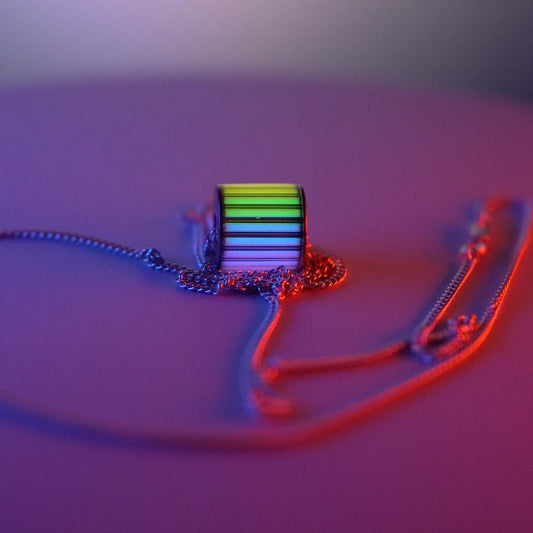
That is the appeal of a pendant with some eccentricity. It gives the eye something to pause over without requiring an entire outfit built around it. A plain button-down, a faded sweater, or a black dress can make room for one irregular form. The necklace does not have to be large. In fact, a small pendant with an unexpected profile often feels more individual than a much bigger piece covered in decoration. A bent bar, a lumpy bead, a tiny hand, a dark stone with a rough edge, or a polished metal shape that refuses to be symmetrical can carry plenty of presence.
The body matters as much as the pendant itself. A necklace that looks amusing in a jewelry tray can feel awkward if it lands too high at the throat or swings constantly into the neckline. The chain length changes the whole impression. Near the base of the neck, a compact pendant can feel intimate and slightly sharp. A longer chain lets it move across the chest, where its shape becomes more visible as the wearer walks or reaches for a coffee cup. Some pendants rotate to show a dull back, which can be part of their charm, but a thin, unfinished reverse side tends to become irritating over time.
Weight is easy to underestimate. A substantial pendant may hang beautifully for the first hour and then pull the chain forward, leaving the clasp creeping around the neck. Very light pieces have their own problem: they can flip in a breeze or disappear beneath a shirt collar. The most wearable examples have enough weight to stay oriented without feeling like a small object tugging at the skin. A smooth bail, a chain that does not catch on hair, and a clasp that can be fastened without a struggle matter more than they sound like they should.
Material gives the strange shape some authority. Sterling silver with a brushed or oxidized surface tends to make an unconventional pendant feel grounded. The darker recesses stay visible as the raised areas brighten through handling, and small scratches usually blend into the finish rather than ruining it. High-polish silver catches light dramatically but shows fingerprints and scuffs quickly. Gold has a warmer, quieter effect, particularly when the pendant is abstract rather than decorative. Brass can develop a deeper, uneven patina near the edges and around textured details, though some people will find the change attractive while others will miss the original brightness.
Colorful materials shift the mood. Enamel can look wonderfully solid when it is applied cleanly, especially in a saturated blue, tomato red, or milky white. Resin has a softer visual presence and can hold marbling, flecks, or translucent pockets that change in different light. It also tends to pick up scratches and may feel lighter than expected. Stones bring their own irregularities. A piece of turquoise with visible matrix, a cloudy moonstone, or a striped agate does not need to be perfectly clear or evenly colored. Those variations keep the pendant from looking too resolved, which is often exactly what makes it interesting.
Craftsmanship shows up in the places people do not notice immediately. The hole drilled through a stone should not have a sharp rim. A cast-metal pendant should not leave rough edges that catch on knitwear. If a piece contains moving parts, they should move with a deliberate resistance rather than rattle like loose hardware. A handmade appearance is not the same as careless construction. The best unusual jewelry may look a little offbeat, but the surfaces still feel considered, and the connection between pendant and chain does not seem like an afterthought.
There is also something useful about a necklace that does not announce a fixed style. A playful pendant can sit beside a fine chain and look delicate, or next to a heavier silver necklace and become part of a rougher combination. Layering works best when the pieces are allowed to disagree slightly. A smooth chain next to a textured pendant, or a muted metal beside one bright element, can feel lived-in rather than arranged for a photograph. Too many competing shapes, though, turn the neckline into a collection of separate ideas.
People often buy these necklaces during periods when their usual jewelry feels too predictable. A gift can have the same effect. Someone may not want a conventional heart or initial, but they might wear a pendant shaped like a crescent, a small shell, an abstract eye, or an object connected to an old interest. The meaning does not need to be explained every time it is worn. Sometimes the appeal is simply that it recalls a place, a joke, a particular color, or a version of the wearer who was willing to choose something less sensible.
The pieces that stay in rotation are rarely the most attention-seeking ones. They are the necklaces that work with a familiar jacket, that do not snag when a scarf is pulled on, and that still look good after the surface has picked up the marks of ordinary use. A pendant may lose its showroom brightness and gain a softer edge where fingers touch it or fabric brushes against it. At that point, its peculiar shape can feel even more natural, as though it has finally settled into the small space between decoration and habit.