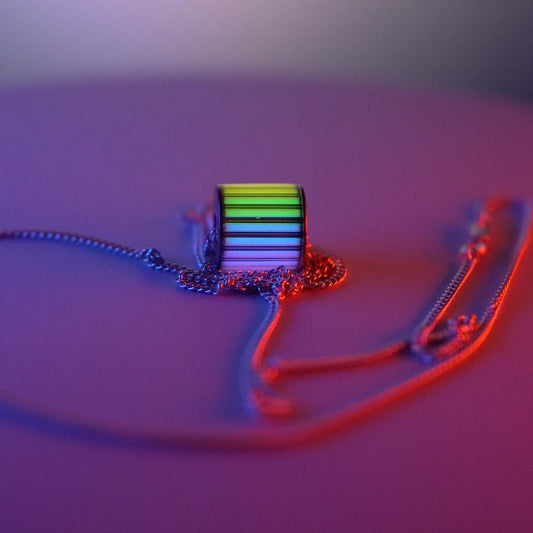
Choosing Unique Sterling Silver Pendants by Shape, Scale, and Texture
Choosing Unique Sterling Silver Pendants by Shape, Scale, and Texture
Sterling silver is especially good at this kind of quiet visibility. Its color is cooler than yellow gold, though not as stark as polished white metal. Against a black T-shirt, it can look crisp and almost graphic. Against a cream sweater, its surface tends to soften. A high-polish pendant throws back quick points of light, while a brushed or oxidized finish shows its shape more slowly. Texture matters because pendants are usually seen at a distance first. A simple form with a hammered surface may have more life across a room than a perfectly smooth disc.
The most interesting unique sterling silver pendants are not always unusual in a loud or eccentric way. Sometimes the difference is in proportion. A narrow vertical piece can lengthen the line of an open shirt without looking formal. A heavier, rounded pendant may sit close to the sternum and feel almost like a small object chosen for its weight. Some have irregular edges, visible tool marks, or a stone that is slightly off-center. Those details keep the piece from looking as if it came from a perfectly repeated mold, even when the overall design remains easy to wear.
Scale becomes obvious once a pendant is on the body. A pendant that looks modest in a display case may feel substantial against a bare neck. A very light charm can disappear under a thick knit, while a broad silver shape may catch on the fabric or tilt outward. The chain affects this as much as the pendant itself. A fine chain lets a sculptural piece seem to float, but it may feel mismatched if the pendant has real weight. A thicker chain can make a small pendant look more deliberate and gives the necklace a better chance of staying centered during the day.
This is where craftsmanship becomes practical rather than abstract. The bail, the small fitting that connects the pendant to the chain, should move freely without looking flimsy. Edges need enough finishing that they do not snag a shirt collar or scratch the skin. The chain should lie naturally instead of twisting every time the wearer moves. These are minor details until a necklace is worn for eight hours. Then a sharp edge, a weak clasp, or a pendant that constantly flips becomes the reason it stays in the drawer.
Silver also records use in a way many people come to appreciate. Polished surfaces pick up fine scratches. Raised areas become brighter from contact, while recessed textures darken with tarnish and handling. A pendant worn often may lose the untouched look it had at first, but its surface begins to describe a routine: the same chain marks, the softened corners, the places where fingers have held it while fastening the clasp. Some people clean their silver until it shines like new. Others prefer the darker traces because they give a relief design more depth. Neither approach is inherently better. The appeal is partly in being able to choose how finished the piece should look.
A pendant can also carry meaning without looking ceremonial. A small geometric form might recall an architectural detail someone noticed on a trip. A shell, crescent, hand, or abstracted botanical shape can stand for something personal without announcing the story to everyone nearby. This makes sterling silver useful for gifts, particularly when the giver knows the recipient’s habits better than their wardrobe. A pendant does not require an exact size, and it can be worn under a blazer, with a plain sweater, or over a weekend T-shirt. The best gifts in this category often feel observed rather than generically romantic: a shape connected to a place, a texture suited to someone who wears denim and linen, or a stone chosen for its muted color instead of its supposed properties.
Layering changes the mood again. A distinct pendant usually works better with fewer competing pieces around it. Two fine chains at different lengths can make a small silver pendant feel integrated, while several similarly sized charms may turn its outline into visual noise. There is also something appealing about wearing a pendant with unrelated jewelry: silver at the throat, a worn leather watch, perhaps a plain gold ring. The combination feels lived in. It suggests that the wearer is choosing pieces by attachment and habit, not assembling a matching set.
Certain pendants stay in rotation because they solve several small problems at once. They have enough shape to be noticed, enough comfort to forget, and enough character to keep looking different in changing light. Sterling silver gives them room to develop. A new pendant may begin as a clean, reflective object, then gradually take on the quieter surface of something that belongs to one person’s daily life. Often that is when its oddities become most convincing: the slightly uneven edge, the stone that is not perfectly uniform, the mark that appears only when the necklace turns near the collarbone.