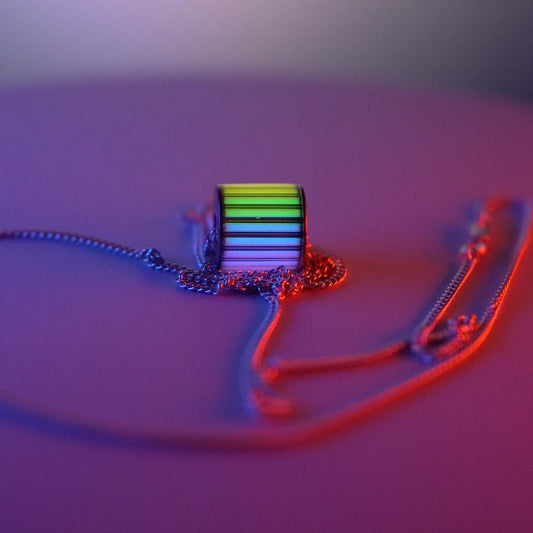
Natural Opal Jewelry Shifts Color With Light and Movement
Natural Opal Jewelry Shifts Color With Light and Movement
This makes opal jewelry feel less fixed than many other gemstone pieces. A diamond tends to give back the light in a crisp, immediate way. A sapphire usually holds its color steadily. Opal is more dependent on angle, light, and the distance between the stone and the observer. In a pendant resting near the collarbone, its colors may surface as the wearer walks or turns their head. Opal earrings can be especially engaging because the stone is constantly shifting with movement, though a small stud often shows its character more clearly than a large, elaborate drop.
The most interesting opals are not always the loudest ones. A stone filled with red, orange, green, and blue can be striking, but a restrained gray opal with a thin wash of blue may be easier to wear every day. White opal has a gentler presence, especially in yellow gold, where the warm metal brings out its cream and peach tones. Black or dark-bodied opal creates more contrast, and its flashes can seem sharper against the deeper background. Boulder opal, with traces of its ironstone matrix left visible, has a more irregular, earthy appearance. The dark lines and patches are not flaws to be hidden; they are part of the stone’s particular structure and give a finished piece a less polished, more geological feeling.
That irregularity matters in design. Opal often looks best when the setting leaves enough of the stone visible to show how it changes. A heavy border can make a small cabochon appear even smaller, while a low bezel gives the piece a calm, substantial outline. Prongs reveal more of the surface but can leave the edges exposed, which is not always ideal for a stone that is more vulnerable to knocks than harder gems. Silver and white gold emphasize cooler flashes and can make a pale opal look crisp. Yellow gold tends to make the whole piece feel softer and slightly older, even when the design is new. Rose gold can be beautiful with pinkish or peach tones, although too much warmth may blur the contrast in a delicate stone.
The shape also changes the experience. A smooth oval has an easy, familiar presence, while an uneven freeform opal can look as if the setting was built around the stone rather than the other way around. That kind of asymmetry works well in a ring or pendant worn alone. It is harder to layer with other pieces without looking deliberately arranged. A simple opal necklace, on the other hand, often settles naturally among chains of different lengths because the stone’s color provides interest without needing an elaborate silhouette.
Wearability is where opal requires a little honesty. It is not a gemstone to treat casually in the way some people treat a plain gold band. Opal is relatively soft, and its surface can scratch. Rings receive the most punishment from countertops, door handles, keys, and the unconscious habit of using one’s hands as tools. A low-profile ring with a protective setting can be worn regularly, but an opal ring is usually better suited to someone willing to remove jewelry for cleaning, gardening, workouts, or rough work. Pendants and earrings are less exposed and often make more practical choices for frequent wear.
Water and sudden changes in temperature deserve attention as well. Many solid opals tolerate ordinary life, but repeated soaking, heat, or harsh cleaning can be unkind, particularly to treated or assembled opals. Doublets and triplets have layered construction, and their edges may be more sensitive to moisture than a solid stone. A soft cloth is usually enough for routine cleaning. Ultrasonic cleaners, steam, abrasive cloths, and household chemicals are poor matches for opal jewelry, even when the surrounding metal seems sturdy. The clasp, chain, or back of an earring may hold up perfectly while the stone itself quietly accumulates damage.
This is part of why an opal piece can become closely tied to habit. Someone may wear an opal pendant every Friday because it works with a work shirt, a sweater, and a dress without looking like an occasion-only object. Someone else may keep an opal ring for dinners and gatherings, taking it off before the practical parts of the day begin. Over time, the piece’s place in a jewelry box becomes less about its value and more about the particular gestures around it: fastening the chain before leaving, turning the ring toward a window, noticing that a favorite flash is still there.
Opal also carries a sense of individuality without requiring an unusual design. Even stones cut from the same rough can differ in pattern and color. That makes the material especially fitting for gifts connected to a birthday, a new beginning, or a personal milestone, though the meaning tends to come from the relationship and the repeated wearing rather than from a fixed symbolism attached to the stone. An opal chosen well does not need to announce a story. Its changing surface leaves room for the wearer to supply one.
Some jewelry becomes part of a person’s outline: a chain visible at the open collar, small earrings moving when they laugh, a ring briefly catching light as they reach across a table. Natural opal works in those moments because it does not show exactly the same face twice. Its appeal is modestly unpredictable, and that is often what keeps it from feeling finished or overfamiliar.