The Unique Appeal and Wearable Comfort of Vintage Artisan Jewelry
The Unique Appeal and Wearable Comfort of Vintage Artisan Jewelry
That is part of the appeal of vintage artisan jewelry. It tends to show how something was made. You may see a solder line inside a setting, a hand-hammered texture that changes from one side to the other, or a bezel with a slightly softened edge. These details are not automatically signs of superior workmanship. Some pieces are awkwardly finished, and some clasps have plainly had a hard life. But the evidence of the maker’s hand makes the jewelry easier to look at for a long time. There is something to follow with the eye.
The best pieces usually have a tension between irregularity and control. A pendant can be asymmetrical without looking accidental. A pair of earrings may not match down to the millimeter, yet balance properly once they are worn. The metal might have a warm, muted tone rather than a bright showroom shine, with darker color settled into the recesses of a pattern. That surface is especially noticeable near the face. A brushed or oxidized finish absorbs light, while a polished edge flashes when the wearer turns their head.
Wearability becomes clear only after a few hours. A large pendant that looks compelling laid flat may keep tipping sideways on the collarbone. A heavy pair of earrings can pull at the lobe by late afternoon, even if the movement is attractive at first. Older bracelets often have a satisfying weight, but a loose hinge or stiff clasp changes the experience quickly. The jewelry may be beautiful, yet remain in the drawer if it pinches, snags knitwear, or requires constant adjustment.
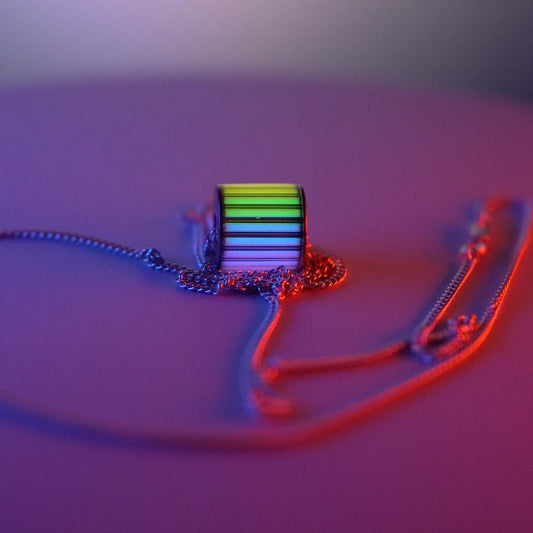
Necklaces are particularly revealing in daily life. A hand-shaped or uneven pendant often settles into one favored position, resting just below the collarbone with the chain disappearing beneath a shirt neckline. Layered with a fine modern chain, it can look unplanned in the best way, as if the pieces accumulated through different years rather than being selected as a set. Shorter necklaces are less forgiving. If the pendant lands directly at the base of the throat, its weight and texture become part of the wearer’s awareness all day.
Gemstones in vintage artisan jewelry often have a quieter presence than their commercial counterparts. Cabochons may show cloudy color, mineral markings, or a variation in polish that makes each one slightly different. A piece of turquoise can have a web of brown matrix, a moonstone can shift from gray to blue only at a certain angle, and an old garnet may look almost wine-dark indoors before showing red near a window. These stones do not always produce a dramatic first impression. Their interest develops through movement and changing light.
The setting matters just as much. A stone held in a simple bezel feels protected and substantial, though it may sit closer to the skin. Prongs can show more of the gem, but older ones deserve a careful look because worn tips are not merely cosmetic. A ring that has been worn for decades may have a smooth, comfortable interior while the setting above it needs attention. The contrast is common in vintage jewelry: the part touching the body can be beautifully broken in, while the part exposed to knocks has accumulated practical problems.
Metal changes in similarly visible ways. Sterling silver darkens, polishes up at the high points, and develops a soft contrast around engraved or textured areas. Gold retains its color but gathers fine scratches that can make a once-bright surface look more settled. Copper and brass may leave a trace of color on the skin, especially in heat or humidity. That is not necessarily a flaw, though it does affect whether a piece fits easily into a person’s routine. Jewelry meant to be worn regularly has to cooperate with real skin, real clothes, and the occasional forgotten removal before a shower.
The cultural references in artisan jewelry can be compelling, but they call for some restraint. A geometric pattern, carved figure, or particular stone may carry meaning that cannot be reduced to an appealing visual detail. Without reliable information about its origin, it is better to appreciate what is visibly present than to invent a history for it. A hand-worked surface can be admired as a surface. Its mystery does not need to be filled with assumptions.
Gifting this kind of jewelry can be intimate in a way that is not always comfortable. A vintage brooch may suit someone who already wears jackets, scarves, or unusual pins, but feel like a costume to someone who prefers minimal jewelry. An artisan ring brings even more personal risk because fit, proportion, and tolerance for irregularity vary so much. The most successful gifts tend to recognize an existing habit rather than announce a new identity for the recipient.
Over time, certain pieces become associated with ordinary routines instead of occasions. A small pendant worn under a sweater. A ring that has become familiar enough to disappear until it catches the light while washing a dish. Earrings that move when someone laughs or turns to answer a question. Vintage artisan jewelry earns its place this way, not by remaining untouched or looking perpetually new, but by becoming comfortable with the marks, gestures, and small inconsistencies of a particular life.