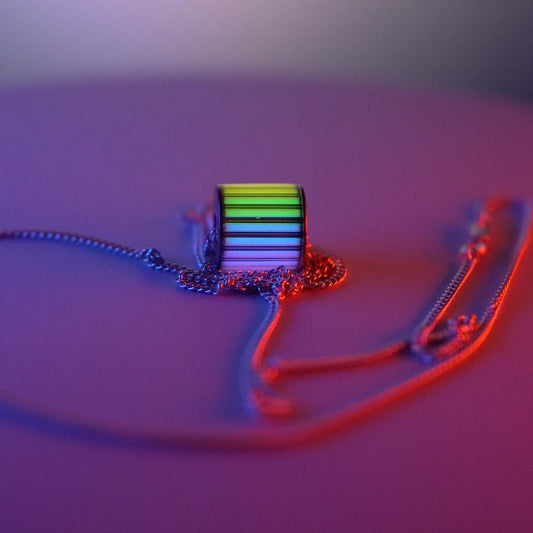
Unique Artisan Jewelry
Unique Artisan Jewelry
Last fall I was standing in line for coffee when I noticed the woman in front of me wearing a pair of earrings that looked like tiny, crumpled pieces of gold leaf. They weren’t symmetrical. One sat slightly higher than the other, and the edges were uneven in a way that clearly wasn’t accidental. I kept staring at them, trying to figure out if they were delicate or rugged. That little moment stuck with me more than any billboard ad ever has. That’s usually how unique artisan jewelry enters my life—not through a campaign, but through someone’s shoulder, wrist, or collarbone.
In the U.S., there’s been a quiet shift in how people buy jewelry. For a long time, “nice jewelry” meant predictable: smooth finishes, standard gemstones, clean lines you’ve seen before. But lately I’ve noticed more people—especially women in their late twenties through forties—leaning toward pieces that look a bit irregular. Hammered silver with visible tool marks. Rings set with oddly shaped sapphires instead of perfect rounds. Necklaces where the chain is slightly heavier than you’d expect. There’s something about seeing the maker’s hand in the piece that feels grounding.
I don’t think this is just about aesthetics. It’s about trust and identity. When someone buys artisan jewelry, they’re often buying the story of how it was made. Not in a dramatic, documentary way, but in a quiet reassurance that an actual person shaped the metal, set the stone, made the tiny decisions along the way. In a market flooded with mass production, that human touch feels rare. And rarity, even in small doses, changes how we value something.
Materials play a big role in this shift. I’ve seen a growing appreciation for unconventional stones—rose-cut diamonds that show their inclusions, salt-and-pepper diamonds with visible specks, turquoise with heavy veining. Ten years ago, many buyers would have rejected those as “flawed.” Now those so-called flaws are often the reason someone falls in love with a piece. It reminds me of how people started preferring solid wood tables with knots and grain patterns over perfectly smooth composite surfaces. Imperfection reads as real.
There’s also a tactile aspect that’s hard to ignore. Artisan jewelry often has weight. Not always heavy, but substantial enough that you notice it when you put it on. I once tried on a hand-forged cuff bracelet that had a slight bend to fit the wrist rather than a perfectly uniform curve. It felt like it had been shaped around someone’s arm, not stamped out by a machine. That sensation—metal that feels alive rather than sterile—can change how often you reach for it.
Another angle I see in the U.S. market is how people use artisan pieces in everyday settings. It’s no longer just “special occasion” jewelry. I’ve met women who wear a chunky handmade ring with jeans and sneakers, or a rough-textured pendant with a basic white tee. The contrast is intentional. There’s something satisfying about pairing something visibly crafted with something completely ordinary. It signals that the jewelry isn’t locked away for anniversaries; it’s part of daily life.
I’ve also noticed that buyers of artisan jewelry tend to think longer before purchasing. They’ll ask questions about where the metal was sourced, or how the stone was cut. Not in a suspicious way, but in a curious one. They want to know if the piece will age well, if the patina will deepen, if it can be resized years down the line. That kind of consideration changes the relationship with the object. It becomes less about trend and more about longevity.
Of course, not every handmade piece is automatically meaningful. I’ve seen plenty of so-called artisan jewelry that feels rushed or overly stylized, as if quirkiness alone makes it special. For me, the difference is intention. When a design choice feels thoughtful—even if it’s bold or unconventional—it resonates. When it feels like randomness for the sake of being different, it falls flat. Buyers are surprisingly good at sensing that difference.
There’s also an emotional layer that’s hard to quantify. A friend of mine bought a hand-carved pendant after finishing a difficult year at work. It wasn’t flashy, just a simple oval with subtle engraving. But she told me she liked knowing that someone else had spent hours shaping it. That sense of shared effort—maker and wearer connected through time—gave the piece more weight than its size suggested.
In a market saturated with identical options, unique artisan jewelry offers something slightly unpredictable. Not chaotic, just personal. It invites you to look closer, to notice the tiny asymmetries, the texture, the decisions behind the design. And once you start noticing those details, it becomes surprisingly hard to go back to jewelry that feels anonymous.