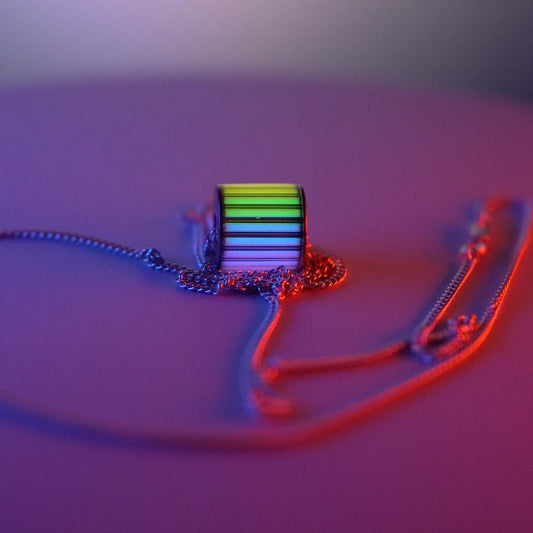
Iridescent Turquoise Color Shifts in Light and Complements Different Metals
Iridescent Turquoise Color Shifts in Light and Complements Different Metals
That subdued movement is part of its appeal. Ordinary turquoise has a mostly opaque, chalky or waxy character, with color carried by the stone itself rather than by transparency. An iridescent-looking piece introduces another layer. The polish, the structure of the stone, its matrix, or a surface treatment may all contribute to the way it reflects light. Some pieces have a natural-looking sheen that appears within the material. Others may be coated, stabilized, reconstituted, or made from a composite. Those differences are not minor if you are interested in how the piece will age. A surface effect can soften, scratch, or wear away in places that rub against skin and clothing, while color and pattern held deeper in the stone tend to remain more convincing over time.
In person, the metal choice changes the whole mood. Bright silver makes the blue seem cooler and more Southwestern, especially when the setting leaves an uneven edge of stone visible. Oxidized silver brings out dark lines in the matrix and can make the piece feel older than it is. Yellow gold does something less expected. Against it, iridescent turquoise can look almost tropical, with the green notes becoming more noticeable and the stone losing some of the formal associations people bring to turquoise. A small gold pendant near the collarbone may read as delicate, while the same stone in a heavy silver bezel feels grounded and substantial.
The setting matters just as much. A smooth cabochon in a low bezel is easy to wear because there are no sharp corners to catch on a sweater, though its quiet surface can disappear under a shirt collar. A high-set ring shows the color shift beautifully when the hand moves, but it also invites knocks against countertops, doorframes, and the hard edge of a laptop. Turquoise is not an especially hard gemstone, so a ring with a raised stone asks for more care than a pendant. That is not a reason to avoid it. It simply explains why some turquoise rings become occasional pieces while necklaces stay in regular rotation.
Earrings are especially good at showing what iridescence can do. A stud may reveal only a small patch of color, but a drop earring turns with the head and catches light in brief, uneven flashes. The effect is noticeable without being loud. In a room where everyone is wearing polished gold hoops or clear stones, a pair of blue-green drops can look personal rather than decorative. Weight becomes important, though. A large stone may be visually airy and physically tiring, especially in a style with a long metal ear wire. The best pair is often the one that moves when you move but does not pull at the lobe by the end of dinner.
Iridescent turquoise also layers differently from more predictable blue jewelry. It can sit beside plain silver, brushed gold, or a narrow chain without looking carefully arranged. The green and blue shifts give it enough variation to bridge other colors, while the opacity keeps it from becoming glittery. I have seen a small turquoise pendant look completely at home over a faded T-shirt, then acquire a sharper character against a black dress. It does not need matching earrings or a coordinated stack. In fact, too much of the same surface can make the effect feel manufactured, as though the jewelry is repeating itself for emphasis.
There is a cultural weight to turquoise that cannot be separated entirely from its appearance. In the United States, many people associate it with the Southwest, Indigenous jewelry traditions, silverwork, open landscapes, and objects meant to be worn for years. Those associations can be meaningful, but they can also flatten a complicated history into a visual shortcut. A piece does not become more authentic because it has a large oval stone, a cluster setting, or an artificially aged finish. The material and workmanship are more revealing than the costume of the design. A modest pendant with a well-fitted bail and a stone that sits securely can feel more honest than an oversized piece built around exaggerated rustic details.
As a gift, iridescent turquoise occupies an interesting middle ground. It has enough color to feel chosen, but the color is not so fixed that it dictates an entire wardrobe. The person who wears mostly neutrals may appreciate the blue-green note near the face. Someone with a collection of silver jewelry may like the way the stone introduces variation without breaking the established metal tone. It can also carry a personal association with a place, a trip, or a period of life without looking like a souvenir. The best examples leave room for that meaning to develop rather than announcing it immediately.
Over time, the small signs of use become part of the decision. Silver darkens in recesses and brightens where fingers touch it. A polished turquoise cabochon may develop fine surface marks, especially in a ring. A coated or treated surface may show wear at the edges first, where the stone meets the setting or where it brushes against skin. None of this automatically ruins the piece, but it changes the kind of beauty it has. Iridescent turquoise is most convincing when it is allowed to remain a material with limits, not held to the impossible standard of looking newly polished every day. Its color is already doing something subtle. It does not need to stay perfectly still while it does it.