Choosing a Colorful Statement Necklace That Looks and Feels Right
Choosing a Colorful Statement Necklace That Looks and Feels Right
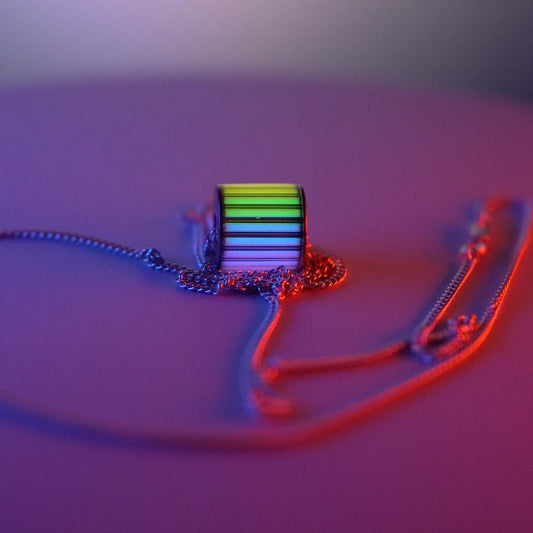
That proximity to the face is also why a necklace that looked appealing on a table can feel wrong once it is worn. Some colors become flatter against certain fabrics, while others seem to brighten in daylight. Glossy beads reflect small, hard points of light; matte stone gives a quieter, more powdery impression. Glass can look almost liquid when the wearer moves, whereas wood, enamel, ceramic, or rough-cut stone brings a little visual irregularity. The best pieces usually have some tension between colors rather than a perfectly matched palette. A slightly muddy green beside a clear yellow can feel more alive than five polished shades chosen to agree with one another.
Scale matters just as much. A necklace can be colorful without being large, and large without being difficult. A row of small beads close to the neck may have the energy of a patterned scarf, while oversized pendants draw the eye lower, toward the sternum. The way it rests changes with the wearer’s body and clothing. A substantial piece may sit beautifully over a crewneck but catch on the edge of an open collar. Long strands shift when someone walks, sometimes settling neatly and sometimes turning so the clasp or backside becomes visible. That movement is part of the character, though it also exposes weak construction quickly.
Weight is often noticed only after an hour. Metal components, dense stone, and multiple layers can feel reassuring at first and then begin to pull at the neck. A necklace that is slightly lighter may stay in rotation more often, especially for workdays, travel, or dinners where the wearer is moving around rather than sitting still. The clasp deserves the same practical attention. A small, stiff closure is irritating when dressing alone, and an awkwardly placed heavy pendant can make the strand twist. These are unglamorous details, but they determine whether the necklace remains in a jewelry box or becomes part of someone’s regular habits.
Material aging can improve a colorful necklace, provided the original surfaces were chosen with that in mind. Brass may develop a softer, darker tone around the edges and where fingers handle it. Plated metal can lose color at the clasp or along areas that rub against skin and fabric. Painted beads may show tiny chips that reveal the material underneath. Some people dislike these changes, while others find that they keep a vivid necklace from looking too new or overly arranged. A polished surface asks for more care and reveals scratches readily. Textured metal and irregular stone tend to absorb the evidence of use.
The necklace also changes depending on what is already being worn. Against a plain cotton shirt, a bright piece can carry the entire visual weight of an outfit. Layered with fine chains, it may look intentional, but only if the lengths leave room around the neck instead of tangling into one bright mass. Small earrings often work better than competing colorful ones, particularly when the necklace has several tones or a large pendant. Still, there are people who wear a colorful necklace with patterned clothes, bright glasses, and rings that do not match at all. The result can be more convincing than careful coordination because it reflects how personal style actually develops: through accumulation, repetition, and occasional disregard for rules.
Color also gives these necklaces a particular place in gifting. A neutral chain can be chosen from a distance with reasonable confidence, but a colorful piece asks the giver to remember something specific: the recipient’s red lipstick, their habit of wearing blue, the dress they reach for at summer gatherings, or the beads they admired years ago. That makes the gift more revealing, and sometimes more successful. It can also miss by a shade. Jewelry worn close to the face becomes part of a person’s visible identity, so preference matters more than the giver’s idea of what is cheerful or flattering.
What keeps a colorful statement necklace in use is rarely novelty alone. It may be the comfortable weight, the familiar clasp, or the particular blue that has become associated with a favorite shirt. Sometimes a piece starts as something worn for parties and gradually appears with jeans, a sweater, or a work jacket because the wearer has stopped treating it as an event object. After enough wear, the colors are no longer simply bright. They belong to certain rooms, seasons, photographs, and ordinary mornings, with a few softened edges that make the necklace feel increasingly like theirs.